Your heating and cooling system moves air through your home every day. That keeps rooms comfortable, but it can also create problems if mold is growing somewhere inside or near the HVAC system.
Many homeowners do not think about mold when they look at vents, air returns, or air conditioning equipment. If moisture builds up in the wrong place, though, mold may begin growing where it is difficult to see.
Once that happens, the movement of air through the system may carry mold particles or odors into other parts of the home.
That is why finding the source of the problem matters.
Why Mold Can Grow Around HVAC Systems
Mold needs moisture to grow, and HVAC systems naturally deal with moisture.
Air conditioners remove humidity from indoor air. During that process, condensation forms inside the system and is supposed to drain away properly.
Problems can begin when moisture does not leave the system like it should.
A clogged drain line, dirty evaporator coil, damaged insulation, leaking duct, or high indoor humidity can all create damp conditions.
Dust can also collect inside HVAC equipment and ductwork. When moisture and organic material are present together, mold may have a place to grow.
Common problem areas may include:
- Air conditioning coils
- Condensate drain pans
- Air returns
- Ductwork
- Areas around vents
- HVAC closets
- Insulation near cooling equipment
- Spaces around leaking ducts
Sometimes the source is not directly inside the HVAC system. Mold may be growing near a duct or air return and the airflow can move odors or particles through the home.
Signs There May Be Mold Near Your HVAC System
Mold around heating and cooling systems is not always obvious.
You may never see a large patch of mold. Instead, you may notice small warning signs.
One common clue is a musty smell when the air conditioner turns on.
If a room smells normal when the system is off but develops an earthy or damp smell when air begins flowing through the vents, it may be worth investigating.
Other possible signs include:
- Musty odors coming from vents
- Dark staining around registers
- Moisture near HVAC equipment
- Condensation around ducts
- Water collecting near the air handler
- Repeated drain line problems
- Damp insulation
- A smell that appears stronger in certain rooms
A smell alone does not tell you exactly where mold is located.
That is where a more detailed inspection can help.
Can Your Air Conditioner Spread Mold?
Your air conditioning system is designed to move air throughout the home.
If mold is growing in or near part of the system, airflow may move mold related particles or odors into other areas.
This does not mean every musty smell coming from a vent proves mold is inside the ductwork. The source could be somewhere nearby.
For example, moisture behind a wall next to an air return could create mold growth. The return may then pull that odor into the HVAC system and move it to another room.
That can make finding the original source difficult.
A homeowner might smell mold in a bedroom even though the actual source is near the HVAC system, inside a wall, or in another part of the house.
Instead of guessing, the goal should be to narrow down where the strongest mold odor is coming from.
How Mold Detection Dogs Can Help
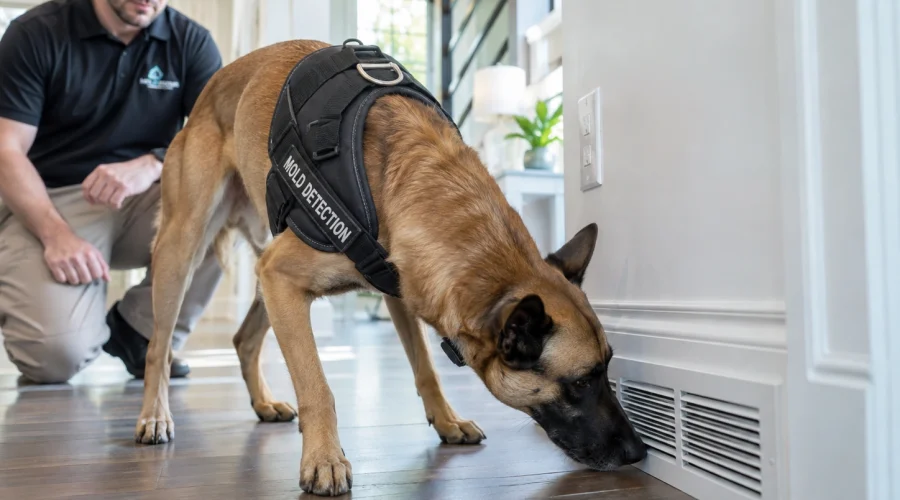
Trained mold detection dogs can be useful when the source of a mold odor is difficult to locate.
Dogs have a powerful sense of smell and can be trained to recognize mold related odors.
During an inspection, a mold detection dog can examine areas around vents, walls, HVAC equipment, baseboards, and other parts of the home.
If the dog alerts in a certain location, that area can be investigated more closely.
This may help narrow down whether a concern is connected to:
- A wall near the HVAC system
- Moisture near ductwork
- An air return
- A hidden leak
- Flooring near HVAC equipment
- Another concealed area nearby
The goal is not to tear apart your entire home looking for mold.
The goal is to identify areas that deserve closer attention so the next step can be more focused.
That can help reduce unnecessary guesswork.
What Should You Do If You Suspect Mold?
If you smell something unusual when your air conditioner runs, do not ignore it.
Start by checking for obvious moisture around your HVAC equipment. Look for standing water, wet insulation, dripping pipes, or unusual staining.
You should also pay attention to where the smell seems strongest.
Does it happen in every room?
Does it only happen when the system runs?
Is one vent stronger than the others?
Those details can help during an inspection.
If the source is still unclear, a professional inspection may help you understand what is happening before repairs or mold cleanup begin.
Finding the location of the problem is important because mold removal will not solve the issue for long if the moisture source remains.
At K9 Mold Dog Inspection, trained mold detection dogs can help locate areas where mold odor may be present, including hidden spaces that are difficult to inspect visually.
If you believe your HVAC system may be connected to a hidden mold problem, scheduling an inspection can help you get closer to the source before the problem has more time to spread.